Search

How can we help?

Icon

Key Provisions found in a Shareholders’ Agreement – Episode 2

This podcast episode is the second in Clarkslegal’s five-part Shareholders’ Agreement miniseries, providing a practical introduction to one of the most important documents for business owners and investors. In this instalment, hosts Emma Docking and Jonathan Hayes, both senior solicitors in a corporate team, explore the key provisions commonly found in shareholders’ agreements.

In this episode, they cover:

  • The purpose of shareholders’ agreements and how they supplement a company’s articles of association.
  • How these agreements strike a balance between majority and minority shareholders, tailored to your business’s unique needs.
  • Key provisions such as ownership structure, decision-making, share transfer mechanisms (including pre-emption rights), and exit strategies.
  • Detailed explanations of drag along and tag along rights, which protect both majority and minority shareholders during a company sale.
  • The importance of planning for shareholder exits and leaver provisions, distinguishing between good and bad leavers and how their shares are treated.
  • The overall strategic and protective role of shareholders’ agreements in aligning expectations and minimising conflicts.

Contact our shareholder agreement experts

If you have questions about shareholders’ agreements or need advice tailored to your business, contact our experienced lawyers today to discuss how we can help protect your interests and strengthen your company’s governance.

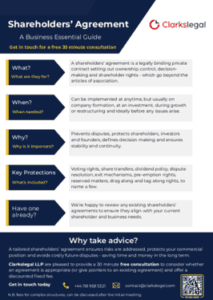
A Business Essential Guide

Click on the guide below or click here for more information and to access our comprehensive guide.
Shareholders’ Agreements Icon

Get in touch for a free 30 minute consultation.

Next episode: Shareholders’ Agreements for Founders and Investors

Meet the speakers

Emma Docking

Senior Solicitor

View profile

+44 118 960 4612

Jonathan Hayes

Senior Solicitor

View profile

‪+44 118 960 4611

Read, listen and watch our latest insights

art
  • 20 November 2026
  • Corporate and M&A

Buying or investing in a company: Understanding the implications of the National Security and Investment Act

The National Security and Investment Act 2021 (NSIA) allows the UK Government to scrutinise and intervene in transactions that could harm national security. Buyers and investors should assess its requirements early and allow time for any necessary approval before completion.

art
  • 16 November 2026
  • Corporate and M&A

Shareholders’ Agreements for Shareholders and third-party buyers – SHA Series Part 4 of 5

A shareholders’ agreement is a private contract between the shareholders of a company which govern how the company is run, how shares are transferred and how potential disputes are resolved.

art
  • 26 October 2026
  • Corporate and M&A

Shareholders’ Agreements for Founders and Investors – SHA Series Part 3 of 5

A shareholders’ agreement is arguably one of the most valuable corporate governance agreements (along with articles of association) in any private UK company with more than one shareholder.

art
  • 23 September 2026
  • Corporate and M&A

GDPR Privacy Policies: Key requirements for organisations

When an organisation is creating a website or app to reach users or potential customers drafting a Privacy Policy may be an afterthought. However, failure to write a Privacy Policy, which complies with the relevant legislation, can have serious consequences.

art
  • 14 September 2026
  • Corporate and M&A

Key provisions found in a Shareholders’ Agreement – SHA Series Part 2 of 5

Discover the key provisions in a shareholders’ agreement, including ownership, decision-making, share transfers, exits and leaver clauses.

Pub
  • 07 September 2026
  • Corporate and M&A

Frequently Asked Questions About Shareholders’ Agreements – Episode 1

Join Emma Docking and Jonathan Hayes as they explore some of the most frequently asked questions about shareholders’ agreements, including what they are, how they work alongside articles of association, and the risks of operating without one.