Key provisions found in a Shareholders’ Agreement – SHA Series Part 2 of 5
- 14 September 2026
- Corporate and M&A




A shareholders’ agreement governs the ongoing relationship between shareholders, supplementing the company’s articles of association. A well-drafted agreement should ensure provisions balanced between majority and minority shareholders, whilst reflecting the businesses specific needs and shareholders’ expectations on the whole.
There are many provisions a well-tailored shareholders’ agreement should cover, and this article will summarise those we would expect to see, depending on the needs of a business. Please note, each company is different and may not require (or it may not be suitable) to include some specific provisions.
A shareholders’ agreement will record the ownership of the company, by setting out details of each shareholder party to the agreement (this doesn’t need to be all shareholders) and their respective shareholdings. The agreement will also include what classes of shares are in issue, the rights (i.e., voting, dividend and capital rights) attached to each and what they mean for each shareholder. Further details around how voting is undertaken and how profits will be distributed are also usually detailed. By doing so, provides clarity regarding the economic interests and control from the outset, reducing any ambiguity and potential future disputes.
An important function of the shareholders’ agreement is to regulate and control how the company is managed and how decisions are made. The agreement should therefore seek to provide clarity on the number of directors required to make a decision, how they will be appointed or removed, and quorum requirements. Similarly, it would be usual to see certain fundamental decisions (e.g., issuing of shares, entering into significant contracts, borrowings in excess of £X amount) being reserved for specific shareholder approval, either by special or unanimous consent. This ensures key company decisions are first agreed by a class of shareholders, prohibiting a unilateral decision being made by management or majority shareholder alone.
Key provisions around how existing shares are transferred is commonly an important topic in the early stages of preparing a shareholders’ agreements, especially when they are silent in the Model Articles. Existing shareholders will want the right of first refusal (i.e., be offered the right to purchase shares from a selling shareholder) before they are sold to a third party, known as ‘pre-emption rights’. Including pre-emption rights and permitted transfer mechanisms provide pivotal anti-dilution protections for existing shareholders.
Depending on the business strategy, we often see drag along rights and tag along rights, protecting both the majority and minority shareholders. Drag along rights enables majority shareholders to compel minority shareholders to sell their shares in a company sale to a willing third party wanting to buy 100% of the company, on the same terms. Tag along rights on the other hand protects the minority shareholder by ensuring they join in on a sale, on the same terms and conditions offered to the majority shareholder so they are not left behind on a deal. These provides flexibility in an exit scenario (especially for founding members) for both majority and minority shareholders. For more information on drag along and tag along rights, please see article Drag-Along & Tag-Along Rights: Why Every Company Needs Them for more information.
A well-drafted agreement should ensure provisions balanced between majority and minority shareholders, whilst reflecting the businesses specific needs and shareholders’ expectations on the whole.
Planning for exit scenarios is critical as every business founder (and investors) will at some point want to make an exit plan, whilst dealing with their day-to-day business obligations. A shareholders’ agreement should therefore provide a clear framework for any shareholder exit or company sale. This may include mechanisms setting out what is classed as an exit event, how shares are valued and what happens in the event of a deadlock and how to resolve the same.
Where shareholders are also employees of the same company, various leaver provisions should be considered, in the event a shareholder leaves the company or breaches any of their obligations. Leaver provisions distinguish between those that are classed as ‘good leavers’, for example, on retirement or leaving due to ill health, and those classed as ‘bad leavers’, for example, dismissal due to gross misconduct. How their shares will be treated and valued will depend on the type of leaver they are.
In practice, a shareholders’ agreement serves as both a protective and strategic tool, by not only mitigating potential areas of conflict, but by providing certainty in future for the company. For shareholders – whether they are founders, investors or minority shareholders – a carefully drafted shareholders’ agreement is paramount in aligning expectations, preserving lasting relationships and ensuring the success of the business.
If you have questions about shareholders’ agreements or need advice tailored to your business, contact our experienced lawyers today to discuss how we can help protect your interests and strengthen your company’s governance.
Click on the guide below or click here for more information and to access our comprehensive guide.
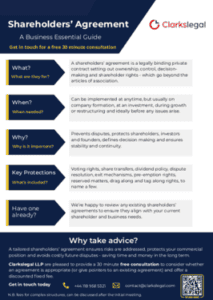
Get in touch for a free 30 minute consultation.
Keep up to date with the latest tips, analysis and upcoming events by our legal experts, direct to your inbox.
Disclaimer
This article is provided for general information purposes only and does not constitute as legal or other professional advice, as it is not comprehensive, fitting for each circumstance and may not be up to date. Specific advice should always be sought in relation to any legal issue and Clarkslegal LLP does not accept any responsibility for any loss which may arise from reliance on any of the information contained on this site.

