Shareholders’ Agreements for Shareholders and third-party Buyers – SHA Series Part 4 of 5
- 16 November 2026
- Corporate and M&A


A shareholders’ agreement is a private contract between the shareholders of a company which govern how the company is run, how shares are transferred and how potential disputes are resolved. In last months article, we discussed the importance of these agreements specifically for founders and investors. They are, however, equally as important for existing shareholders and third-party buyers looking to acquire shares in the company.
This month’s article focusses on the benefits of shareholders agreements for existing shareholders and third-party buyers, some key provisions and practical considerations when looking to implement the same.
Unlike the public markets, shares in private companies cannot usually be freely traded. Because of this, a third-party buyer looking to acquire all (or part) of a company, would first need understand whether the company has a shareholders’ agreement in place. Often just as important as the share purchase agreement used to purchase existing shares, for third-party buyers, an existing shareholders’ agreement determines what is received after completion especially as most shareholders’ agreements will require that any new shareholder are bound by existing agreement via a deed of adherence. They do this by restricting transfers of shares, protecting existing shareholders, setting out the rights attaching to those shares as well as clear procedures when a dispute arises. A shareholders’ agreement is often one of the first documents reviewed (along with the company’s articles of association), to understand the process which must be followed to purchase shares.
Most shareholders’ agreements will contain pre-emption rights, which require the selling shareholder to first offer their shares to existing shareholders, before selling to a third-party purchaser. Not only does this protect existing shareholders against dilution of existing ownership but also from unwanted third- party entrants. It gives existing shareholders the right of first refusal by setting out a specified procedure that must be followed, or in the alternative, must be formally waived by (in most cases) passing a special resolution (i.e., obtaining at least 75% approval from existing shareholders). For potential buyers, the implication is that those shares cannot be purchased until the pre-emption procedures have been properly followed or waived in accordance with its terms (or the Companies Act 2006).
Where a shareholders’ agreement has been drawn up specifically to protect, for example, a family run business, it is important consideration is given to allow certain specified transfers to take place, without triggering the pre-emption rights/restriction. ‘Permitted transfers’ can include transfers to family members, affiliates or connected parties, allowing the next generation to continue its ownership within the company, without being first offered to other existing shareholders, who might not have an affiliation.
Other provisions governing how existing shares are transferred are drag-along and tag-along rights. Drag-along rights are majority shareholder rights allowing them to compel or force minority shareholders to sell their shares on the same terms and conditions. For third-party buyers, a drag-along right provides deal certainty, which is critical in acquisitions where buyers commonly desire to purchase 100% of the company, and not just part of it. This also prevents obstruction by a minority shareholder of a potential full clean exit deal.
Tag-along rights on the other hand, are minority shareholder rights allowing those shareholders to join in or ‘tag along’ on a sale initiated by majority shareholders, also on the same terms and conditions. For shareholders, this ensures all shareholders have equal exiting opportunities by ensuring they’re not effectively left behind on a potential exit. This does mean that the buyer may have to acquire more shares than initially intended, however.
Most shareholders’ agreements will contain pre-emption rights, which require the selling shareholder to first offer their shares to existing shareholders, before selling to a third-party purchaser.
Most business relationships begin amicably and without issue. This is where parties’ views are most aligned and there is certainty around running the business. But what happens where a dispute arises over pricing, rights or compliance – how are these handled and regulated? Shareholders’ agreements typically include structured mechanisms to manage and resolve disputes efficiently and minimise any disruption to the company’s business. This includes provisions such as how negotiations are dealt with, mediation, arbitration and what happens in a deadlock.
Shareholders’ agreements are just as important to shareholders and third-party buyers as they are to founders and investors – they are more than just a legal document. It goes beyond a company’s articles by setting out the blueprint to ensure collaboration, management and to mitigate risk going forward.
If you have questions about shareholders’ agreements or need advice tailored to your business, contact our experienced lawyers today to discuss how we can help protect your interests and strengthen your company’s governance.
Click on the guide below or click here for more information and to access our comprehensive guide.
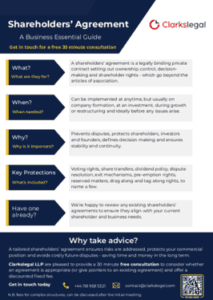
Get in touch for a free 30 minute consultation.
Keep up to date with the latest tips, analysis and upcoming events by our legal experts, direct to your inbox.
Disclaimer
This article is provided for general information purposes only and does not constitute as legal or other professional advice, as it is not comprehensive, fitting for each circumstance and may not be up to date. Specific advice should always be sought in relation to any legal issue and Clarkslegal LLP does not accept any responsibility for any loss which may arise from reliance on any of the information contained on this site.

