Shareholders’ Agreements for Founders and Investors – SHA Series Part 3 of 5
- 22 October 2026
- Corporate and M&A


A shareholders’ agreement is arguably one of the most valuable corporate governance agreements (along with articles of association) in any private UK company with more than one shareholder. They are particularly important in startups and growth-related stages backed by investors. However, whilst the articles of association set out the company’s basic legal framework, one of the biggest drawbacks is its visibility to the public. A shareholders’ agreement on the other hand, provides a tailored, private agreement between shareholders governing how the business is run, providing clarity and sets out how potential disputes or conflicts are handled.
This months’ article explains just some of the important provisions and practical considerations to consider when implementing a shareholder’s agreement to ensure it protects the interests of founders and investors.
Founders often focus on the growth and productivity of a business whilst investors focus on return and mitigating risk, so it is important that they are able to agree on key commercial issues right at the outset of their relationship. By implementing a shareholders’ agreement, it forces both parties to discuss, agree and document those potential future points of contention, setting out a clear, concise path and mitigating risks. If there is a misalignment in expectations, this could lead to costly disputes at time-critical moments, for example, an exit event or funding round, where a shareholders’ agreement is non-existent.
For founders and investors alike, a shareholders’ agreement can include business strategies and a list of reserved actions preventing the company from taking a specific action only once approval sought by a class of shareholders (or, if bargaining power is higher, with ‘Founder Consent’ or ‘Investor Consent’). Similarly, we would expect to see roles and responsibilities included and by documenting these early on, creates clarity and avoids any future ambiguity for both founders and/or investors.
Founders are often concerned about potentially losing control, especially where outside investment is involved. A well-prepared shareholders’ agreement would seek balance among the shareholders, as well as ensuring the founder or investor retains some control over how the business is run.
For founders, various mechanisms are incorporated to ensure key strategic decisions should be protected. Certain decisions – for instance, issuing new shares, amending the articles, taking on further debt – may require either the founder’s or incoming investors consent. Investors who are not directly involved with the business, may also require access to certain information of the company, such as the financials, management information and regular updates, as part of their agreement to inject capital into the company. They may also want to retain some control and have a say on what decisions can be made at board level, as well as have the ability to appoint a representative.
One of the most critical functions of a shareholders’ agreement is the ability to control who can own shares and what occurs on a suggested transfer of existing shares.
Some common provisions governing share transfers are pre-emption rights, drag-along rights and tag-along rights.
Each mechanism protects the rights of existing shareholders and ensures a clean exit for investors or founders.
Founders often focus on the growth and productivity of a business whilst investors focus on return and mitigating risk, so it is important that they are able to agree on key commercial issues right at the outset of their relationship.
Most startup businesses are in a particularly vulnerable position, especially where only one ‘founder’ or key individual of the business is looking to leave. Whether planned over a long period or leaving unexpectedly, without clear provisions in place can create uncertainty around ownership and control. Consideration to include ‘leaver’ provisions should be put in place (but bearing in mind they are not always fit for all companies). What a leaver provision does is where an employee leaves the company, depending on whether they are classed as a ‘good leaver’ (i.e., retirement) or a ‘bad leaver’ (i.e., gross misconduct) will determine the value of their shares and prescribed mechanism to be followed.
Another provision likely to be incorporated are compulsory transfer provisions. These provisions typically coincide with leaver provisions, requiring a shareholder to sell their shares (often at a pre-agreed valuation method) upon a specific triggering event, such as a breach of the agreement, on the death of the shareholder, insolvency, termination of employment, for instance. This provision therefore forces a shareholder to exit by requiring them to sell their shares, when the triggering event occurs, and sets out the mechanism that must be followed in order to effect it.
For founders and investors alike, a shareholders’ agreement isn’t just a formality – it is a strategic agreement use to protect and align interests, whilst providing clarity on various situations.
If you have questions about shareholders’ agreements or need advice tailored to your business, contact our experienced lawyers today to discuss how we can help protect your interests and strengthen your company’s governance.
Click on the guide below or click here for more information and to access our comprehensive guide.
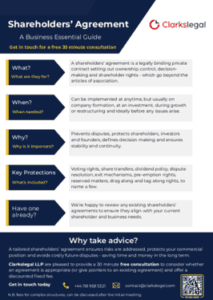
Get in touch for a free 30 minute consultation.
Keep up to date with the latest tips, analysis and upcoming events by our legal experts, direct to your inbox.
Disclaimer
This article is provided for general information purposes only and does not constitute as legal or other professional advice, as it is not comprehensive, fitting for each circumstance and may not be up to date. Specific advice should always be sought in relation to any legal issue and Clarkslegal LLP does not accept any responsibility for any loss which may arise from reliance on any of the information contained on this site.

